Investing
Mika Arai

The invite-only table
Today is Y Combinator's Winter 2026 Demo Day. As you read this, 196 startups are presenting to an invite-only audience of approximately 1,500 investors and press — the culmination of three months of the most intense company-building on the planet. Fewer than 1% of applicants made it into this room.
Harvard accepts around 3%.
You've heard of some of the companies that made YC's cut over the years: Stripe. Airbnb. Doordash. Coinbase. Reddit. Scale AI — which had Meta acquire a 49% stake for over $14 billion in 2025. Together, YC alumni carry a combined valuation exceeding $600 billion, built from a total YC investment of under $1 billion across 5,668 companies since 2005. Under a billion dollars in. Over $600 billion in value out and climbing.
Here's what most people miss: the founders weren't the only ones who've been missing out. For most of YC's history, the investors who got early access to these companies were insiders — people already embedded in Silicon Valley, already connected to great deal flow, already in the right rooms.
If you were a doctor who spent 20 years building a great career, or a tech professional who just had a successful exit, you weren't getting a call. The table was set. You just weren't invited.
This is changing -- the rules around access and conviction are being re-written. In this post, we review Y Combinator's structural position in venture formation, the basis for its outsized returns, and the mechanisms through which accredited investors can now access these opportunities.
What is Y Combinator?
Most venture firms emphasize the strategic value they provide beyond capital. The reality is that few deliver material impact on company trajectory at the earliest stages.
Y Combinator is different — and the data proves it.
It's not a traditional VC fund. It's a startup accelerator. YC invests $500,000 into each early-stage startup it selects, then spends three intensive months helping those companies launch and grow. The program runs four times a year — Winter, Spring, Summer, and Fall — with each batch hosting roughly 150-200startups. Its entire purpose is to help companies take off as fast as possible.
During those three months, founders attend weekly office hours with YC partners, work alongside the companies in their cohort, and tap directly into a network of over 11,000 YC alumni — founders who recently went through the same gauntlet and came out the other side. When you're building and need your first ten customers, your first engineer, or a warm intro to a Series A investor, that network is worth more than most checks.
At the end of every batch: Demo Day. An invite-only event where startups present to the top names in venture capital and press. Rounds regularly close within days — sometimes before Demo Day even ends.
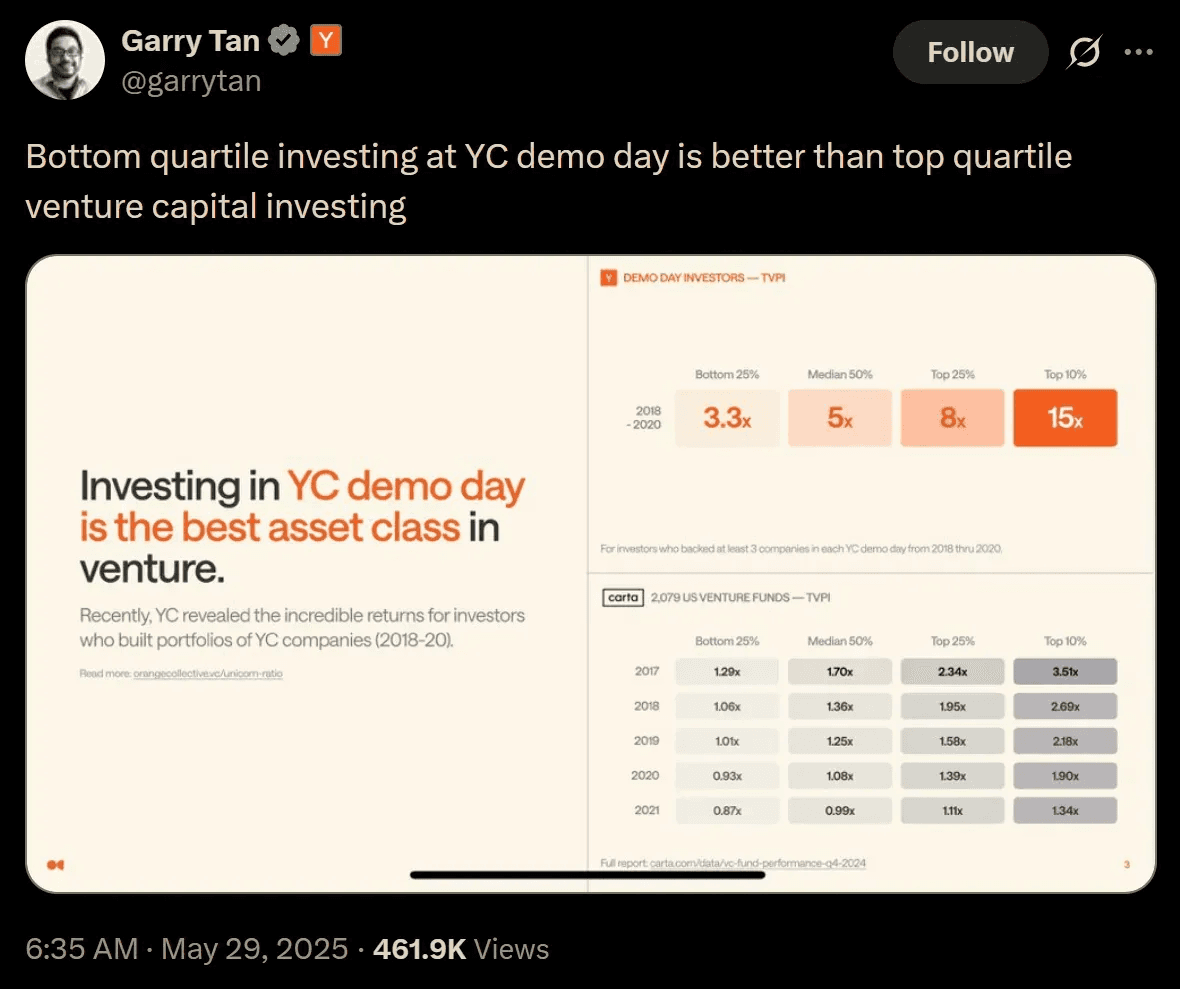
The results speak for themselves. As Garry Tan, YC's President and CEO, stated publicly: "45% of YC companies get to Series A and median ARR is $1M+, trending up. Find me another place where that is true in any set of potential investments in the world." YC has produced 82 unicorns at a rate of roughly 4.5%-6% (depending on cohort) — nearly double the 2.5% rate for comparable startups. And 87% of all YC companies are still actively operating today, versus a typical startup survival rate of around 50% after five years.
Why YC companies tend to win
One statistic stops people cold: YC has backed 20% of all companies valued over $5 billion started since 2012. One accelerator. One in five of the world's most valuable startups. And in 2025, YC was the second most active unicorn investor in the world with 36 new unicorn deals — trailing only Sequoia and a16z. That is not luck. It comes down to three things.
Attracting the best founders. Getting into YC is a gold star on any founder's resume. It creates a self-reinforcing loop: the best founders choose YC, which produces more breakout companies, which makes more top founders want in. YC doesn't chase great founders. Great founders chase YC. That's a structural advantage that compounds every year.
Identifying the best founders. Paul Graham, one of YC's founders, has written that above all else, YC optimizes for great people — not just great ideas. He has said he'd fund a team with no idea at all if he thought they were exceptional enough. YC now receives upwards of 27,000 applications per batch and has refined its judgment across nearly 5,700 companies over two decades. The 10-minute interview that decides whether a team gets $500,000 is the output of 20 years of calibration. Independent analysis of the current W26 batch found that a remarkable 35% of its startups score in the top 20% of all YC companies ever — with analysts calling it "freakishly strong."
Actually helping founders succeed. Most accelerators offer advice. YC offers something harder to replicate: a peer group of hundreds of founders all sprinting at the same time, under the same pressure, toward the same goal. Companies that go through YC together become each other's first customers, first hires, and first investors. Stripe's earliest adopters came almost entirely from their YC batch. That network doesn't expire. It compounds for life.
Why invest in YC companies?
The case for early-stage investing is simple: the earlier you get in, the more upside you capture. The numbers at YC make this more visceral than almost anywhere else.
Airbnb went through YC in 2009 at a seed valuation of roughly $20 million. Its market cap hit $100 billion on IPO day in December 2020 — a 500,000% increase from that original seed valuation. Stripe, which went through YC the same year, was just valued at $159 billion in a February 2026 tender offer, processing nearly $2 trillion in payments annually — up 34% in a single year. Early seed investors in Airbnb, Stripe, Dropbox, Instacart, and DoorDash generated returns exceeding 1,000x. The investors who passed on those seed rounds — and many did — are still telling the story.
This isn't cherry-picking. Research by Rebel Fund, one of the most data-driven YC investors in the world, found that unicorns are a small percentage of all YC companies but account for approximately 90% of all valuation growth across the entire portfolio. That is the power law of early-stage investing in stark relief: most companies return little or nothing, and a small number of outliers produce returns so large they change the whole math. The implication isn't "avoid YC because most companies fail." The implication is "be in the pool that produces the most outliers — and be selective within it."
Now, the risk — stated plainly. This is not a bond fund or a diversified index. Most early-stage startups fail, including some backed by YC. Your capital is illiquid for years. Some positions will go to zero. Rebel Fund's 2025 exit data shows that realized returns for YC investors historically get compelling around Year 10, reaching roughly 20x — but those returns are driven almost entirely by the outlier companies. A sophisticated approach means building enough exposure across companies and batches that the power law eventually works in your favor. Investors who have done well in this asset class didn't bet on one company. They got into the right pool, repeatedly, and let time and diversification do the work.
If that profile fits your situation, here's how to actually get access.
How to invest in YC companies
In general, early-stage companies with institutional backing maintain strict cap table discipline—allocations flow to established investors, strategic operators, and those who deliver direct value beyond capital. Entry typically requires proximity to the founders or coinvestors, and significant capital to write checks across a sufficient number of companies.
Goodfin has spent years building the trust and infrastructure to change that.
Invest through a fund (starting at $10,000)
At Goodfin, we believe investing in great startups shouldn't require a cousin at Sequoia. We create funds that invest in a concentrated group of our top picks from YC — with a minimum investment of just $10,000.
Here's how we think about it: YC has already run one of the most rigorous filters in the world. Our job is to go one level deeper. We look for exceptional founding teams — people with a rare combination of talent, obsession, and execution ability — operating in markets with real tailwinds. We take a small number of concentrated positions rather than spreading thin across dozens of companies, because we'd rather own meaningful stakes in a few companies we genuinely believe in than check boxes across the whole batch.
If you're a Goodfin member and an accredited investor, you can invest in these funds with as little as $10,000 — and get exposure to our picks alongside other investors who take their portfolios seriously.
We also offer something more custom: if you (or a group you invest with) review a YC batch and have conviction about specific companies, we can help you build a fund around exactly those. Higher minimum, but the control is entirely yours.
There is a fund open right now. Today is W26 Demo Day — the companies that just presented are the ones we're evaluating. Spots are limited by design.
Create a Goodfin account and explore the current fund →
Investing in early-stage startups involves significant risk, including the potential loss of your entire investment. Investments are illiquid with long holding periods. Diversification does not guarantee profit or protection against loss. Past performance of Y Combinator companies does not guarantee future results. This document is for informational purposes only and does not constitute investment advice. Only accredited investors are eligible to participate in Goodfin funds.
All statistics verified from primary sources as of March 24, 2026: YC acceptance rate and batch size (ycombinator.com/blog, March 2026); 5,668 companies and $600B portfolio value (ellenox.com, February 2026, analysis of YC public directory); 82 unicorns and 87% survival rate (growthlist.co, March 2026); 45% Series A rate vs. 33% average (Garry Tan, LinkedIn/X, August 2023; Lenny's Newsletter, December 2024); Stripe $159B valuation and $1.9T payments volume (Stripe press release, CNBC, Bloomberg, TechCrunch, February 24, 2026); Airbnb $100B IPO (December 2020); Scale AI Meta deal (ycombinator.com, 2025); 1,000x seed returns for top YC companies and 90% valuation concentration in unicorns (Rebel Fund/Jared Heyman, 2023); 20x DPI at Year 10 (Rebel Fund, July 2025); YC #2 unicorn investor 2025 (Crunchbase, March 2026); W26 batch "freakishly strong" — 35% top-20% companies (Rebel Fund/Jared Heyman, March 2026).
Read More